How Did This Begin?

Number 2 in a series on DNA by Nancy A. Nolette, VFA #1702

As a young girl growing up I remember my father’s reverence for his elders.  He always treated them with respect and honor.  He developed an in depth knowledge of our family’s oral history from these older generation relatives.  Fortunately for the past 30 years I had him document his memory of them.  Some of his family tales seemed outlandish to me yet I have not judged and accepted his present day versions.

In 1976 Alex Haley published his book, “Roots—A Saga of an American Family.”  It was an overnight success causing a 1977 ABC television mini-series based on his book.  I remember being glued to the television each week as Alex Haley’s family history was revealed from Kunta Kinte (1750-1822), Kizzy, Fiddler, Chicken George to present day.  In 1979 a sequel followed with Haley’s visit to the African home of Kunta Kinte.  The History Channel aired a remake of the original mini-series in 2016.  The story of Haley’s African ancestry series inspired a broad interest in genealogy and family history.

More recently several television series have become popular with genealogy research.  The first one that I recall viewing was, “Who do you think you are?”  It was presented initially on NBC then was replayed in later years on the cable channel TLC.  Sometimes you can catch reruns on this cable channel.  The focus was on celebrities who now discovered an unknown line of their ancestry with the assistance of historians and ancestry experts.  With the resurgence of genealogy now, this series will return soon with new personalities.

Another television show on the BYU channel is “Generations Project.”  This program uncovers the hidden identities in a family’s past.  Their focus is for the individuals to know who they are today based on where their ancestors came from.  The participants embark on a journey that immerses them into their family’s past with unknown relatives and places.  The “Generations Project” was limited to a series of 10 stories and was discontinued yet has become a weekly rerun on this channel. 

“Roots Less Travelled” is a half hour presentation geared for teenagers.  Two family members from different generations participate to solve a mystery in their family tree.  They investigate rumors and discover notable moments in history and locations.  It is shown on Saturdays by the NBC television channel.

PBS presents “Finding Your Roots” with host and historian Dr. Henry Louis Gates, Jr.  Dr. Gates explores the ancestry of influential persons from diverse backgrounds.  This feature has been on television for 6 seasons.  Recently added at the conclusion of the genealogy discussion, the individual’s DNA that was collected earlier identifies who also shares it with them.

Another NBC Saturday morning show is “A New Leaf. This program follows ordinary individuals on their self-discovery using family history, genealogy and sometimes DNA analysis to fill in the missing blanks.  Along the way viewers will learn about different cultures discovered by the guest about their family heritage having an understanding of their family history in making important positive life changes.

“Railroad Ties” is a short series sponsored by Ancestry.com.  The current episodes take a personal look at how understanding our family’s past can influence not just who we are, but how we see ourselves.   Historian Dr. Henry Louis Gates Jr. shows the dynamic impact our history has had on identity, family and legacy.

A TLC cable channel program, “Long Lost Family” follows the stories of people who have experienced long term separation from family members and are seeking to be reunited with them.  After fruitless searching, birth parents can reconnect with their biological children who were put up for adoption years ago.  Most often separated siblings are searching for one another.  The hosts have a special connection to these people as they are both adoptees who have embarked on their own journeys to discover their biological families.  Often DNA is needed as a starting point in this search and can validate their genealogy results.

A recent ABC program is the “Genetic Detective” hosted by CeCe Moore.  She has had a diverse career and then years ago ventured into genealogy for family and friends.  When DNA sequencing became popular, she studied Family Tree DNA and how it applied to finding unknown biological parents for adoptees.  Her expertise has morphed into valuable research skills and techniques. 

Today CeCe partners with police departments who have reached a dead end in solving cold case homicides yet have crime scene DNA available.  She uses related DNA to search for genealogical family members by comparing and eliminating them by parentage, generation, sex, age and physical location with the crime scene suspect’s DNA.  CeCe’s says her greatest “bump” in the process is a descendant of an adoptee or divorced parent causing her to relook deeper into the ancestral lineage.  Once the police receive her genetic and genealogy clues, they must use their investigative techniques to validate her conclusions.

Plan to watch these televised programs, search for them with your on-demand channels, try the premium television providers or do online searches to discover how genealogy and DNA can find missing relatives and confirm family lineages.

“We are the sum total of our ancestors…you have the potential of their accumulated sense of possibilities.”

This series continues . . .    
Posted in DNA

What’s In It For Me?

 Number 1 in a series on DNA by Nancy A. Nolette, VFA #1702

What’s in it for me?   Is a reasonable question when you are considering something unknown and new.  Well, I am defining “it” as my DNA or those pesky 23 genes from each of your parents that came at birth.

I am sure you have been told that you look or act like one of your parents, an aunt, an uncle, a grandparent or other close relative.  I have frequently.  Have you ever wondered how you came by those traits?  In the past twenty-five years significant research has evolved to answer a lot of our questions on who we are, where we came from and what influences our future. 

I will begin by mentioning the prominent agencies that collect DNA, our genetic code:  23andMe, AncestryDNA, Family Tree DNA, MyHeritage and GEDmatch.  Today the prices for the analysis kits are reasonable.  Earlier versions included a hidden premium paid for researchers to collect DNA from obscure peoples who lived away from populated areas.  By enlarging the DNA sampling many unique links were identified from their participation in this collection process.

Once you get a kit, you swab your cheek and send the tube to the processing center.  Weeks later you receive the results of your genetic code:  mtDNA for women and Y-Chromosome for men.  Mothers pass their mtDNA (XX) to all her children while fathers pass their Y-Chromosome (XY) only to their sons.  Brothers and sisters share similar genetics at a potential 50% match and can be identified as close relatives.  Only identical twins, not fraternal twins, have the same genetic codes.

Today one privately owned DNA coding, analysis and storage service releases any genetic information to law enforcement.  In the past this genetic coding was only released for identities for homicides and sexual assault cases.  Times have changed due to the overwhelming number of cold cases of millions of victims, including families and friends, of violent crime victims and unidentified remains.  Now GEDMatch users must OPT IN their permission to allow law enforcement access to their DNA coding.  This requirement has closed off access to 95% of the database and made DNA crime solving much more difficult.

To understand, how genetic genealogy helps in solving cases is simple.  It does not identify suspects. Those who OPT-IN may never know if their information has been used to catch a suspect.  One reason law enforcement does not contact users is the risk of alerting a potential suspect.  Law enforcement has no special access as they can only use the system and its features as other users yet only see matches with the OPT-IN kits.  This process gives law enforcement a person or persons of interest where none existed before.  Then they must use the traditional investigative techniques to identify and arrest a suspect.

Now, do I OPT IN or not?  I always thought that if I had nothing to hide why not?  I am thinking otherwise.  We all have an expectation and right to privacy.  Often I hear that if we willingly give up our rights, they will eventually be eroded and then non-existent.

However, my strong sense of justice overrides my privacy rights.   I am in.

The series continues. . .

Posted in DNA

New officers. No reunion.

New officers

Our officers for the 2020-2023 period were elected as of the Triennial Meeting on September 12, 2020. Balloting was done with a combination of mailed-in paper ballots and electronic voting. The votes were unanimous for the slate listed in the most recent newsletter. They are:

David A. Violette, VFA #621, Phoenix AZ, President (re-elected)
Richard G. Violette, VFA #1812, Columbia MD, Vice President
Paul L. Violette, VFA #1589, St Louis MO, Treasurer
Peter R. Violette, VFA #1793, Mineral VA, Secretary

Peter R. Violette is also our new Genealogist.

No reunion

We have no volunteers to host a Reunion, so there are no plans for one.

The next regular date for a Reunion would be 2023, so there is plenty of time for folks to get together and do the planning for it. Contact any of the officers if you would like to host one or if you have questions about doing so.

Have you voted? Meeting this Saturday.

The Triennial Meeting of the Violette Family Association will be held on this Saturday, September 12th. This will be a virtual meeting held using the Zoom meeting system. Instructions for attending this meeting are available here. The Final Agenda has been set, though this may change at the meeting under agenda item 2.

The meeting time depends on your time zone. The meeting will start at 1:00 PM Eastern Daylight Time, Noon Central Daylight Time, 11:00 AM Mountain Daylight Time, 10:00 Pacific Daylight Time and Arizona Time.

An important part of this meeting will be election of officers. Voting may be done by paper ballot postmarked no later than the meeting date. Voting may also be done electronically at the Association’s web site. Only Association members may vote.

September 12th meeting and voting

A reminder that the Triennial Meeting of the Violette Family Association will be held on Saturday, September 12th. This will be a virtual meeting held using the Zoom meeting system. Instructions for attending this meeting are available here. The Final Agenda has been set, though this may change at the meeting under agenda item 2.

The meeting time depends on your time zone. The meeting will start at 1:00 PM Eastern Daylight Time, Noon Central Daylight Time, 11:00 AM Mountain Daylight Time, 10:00 Pacific Daylight Time.

An important part of this meeting will be election of officers. Voting may be done by paper ballot postmarked no later than the meeting date. Voting may also be done electronically at the Association’s web site. Only Association members may vote.

A reminder about elections. Triennial Meeting.

It is time to elect our officers for the 2020-2023 triennium. The recent newsletter contains a ballot for mailing but you can also vote online at VioletteRegistry.com/2020-voting. Either way, your vote must be in before the Meeting in order to count.

Our Triennial Meeting will be held on September 12, 2020. It will be a virtual meeting using Zoom. The newsletter gives you instructions on how to connect with the meeting using your computer, tablet, or smartphone. Check the meeting notice for the meeting time in your time zone.

Newsletter. Triennial Meeting. Voting.

Newsletter

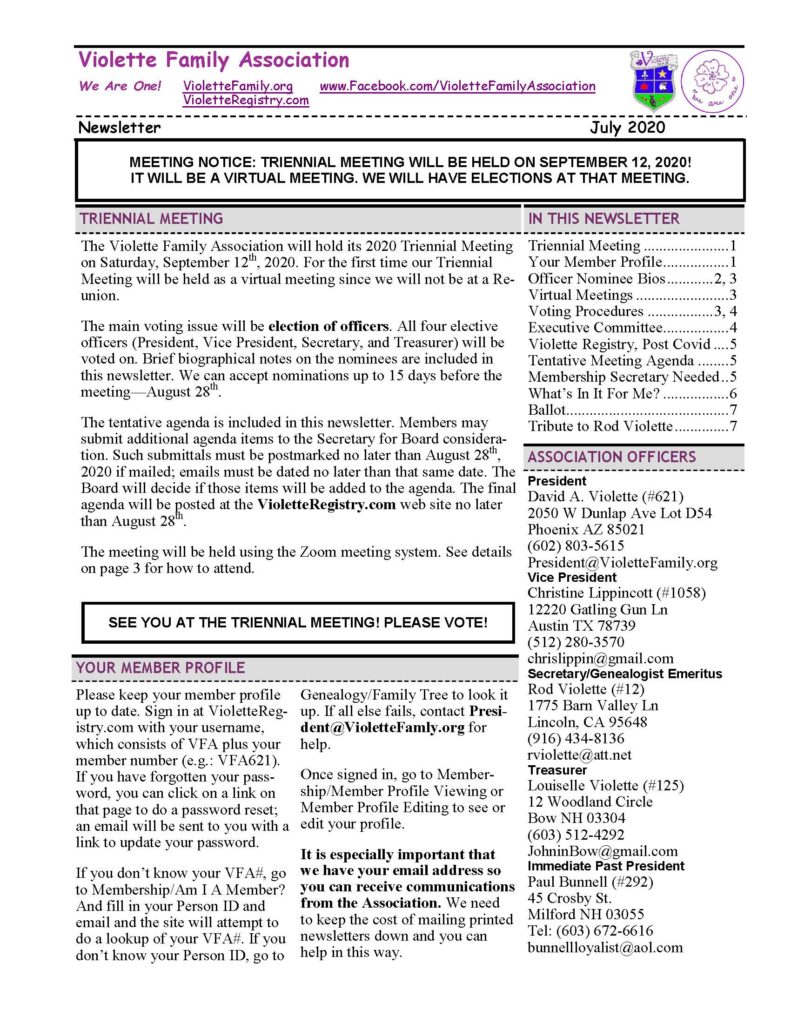
A Violette Family Association newsletter has been published. Printed copies go to those who have not given us an email address, but electronic copies are available through our web site at VioletteRegistry.com/news/newsletters.

This newsletter is devoted to information about the Triennial Meeting to be held on September 12, 2020. It will be a virtual meeting using Zoom. The newsletter gives you instructions on how to connect with the meeting using your computer, tablet, or smartphone. Check the meeting notice for the meeting time in your time zone.

It is time to elect our officers for the 2020-2023 triennium. The newsletter contains a ballot for mailing but you can also vote online at VioletteRegistry.com/2020-voting. Either way, your vote must be in before the Meeting in order to count.

Nominations needed

This is the last call for nominations for President, Vice President, Secretary, and Treasurer. While we have one nominee each for President, Secretary, and Treasurer at this time we have none for Vice President. We can use more than one nomination for all of the offices.

The elections will be held at the Triennial Meeting to be held in late August or early September, and nominations need to be received by June 27th at the latest so they can be included in the next newsletter. That will be published 60 days ahead of the Triennial Meeting.

You can learn more about the duties of each office at VioletteRegistry.com/constitution-bylaws.

Contact President@VioletteFamily.org to make a nomination or to volunteer for an office.

Nominations needed

We are looking for nominations for all of the offices of the Association: President, Vice President, Secretary, and Treasurer. We need those nominations sent to President@VioletteFamily.org no later than May 30, 2020.

The term of office is three years, running from the date of the Triennial Meeting in August 2020 through the date of the Triennial Meeting in August 2023.

The duties of each office are spelled out in Constitution and Bylaws. Download those documents here or go to VioletteRegistry.com/constitution-bylaws/.

Please provide full contact information for any nominee so we can contact them to verify they are willing to be placed in nomination and to serve. Nominees must be members of the Association.

April 2020 newsletter

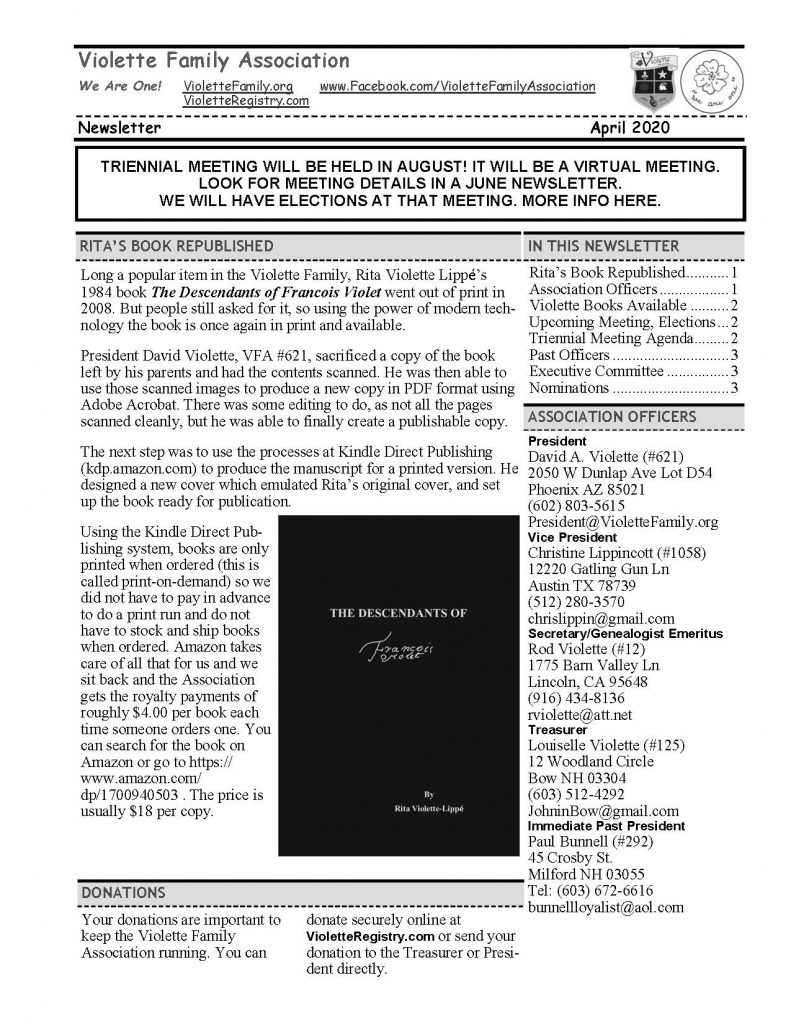
We have published a newsletter in April 2020 telling members about new Violette-related books available from Amazon and setting the state for a Triennial Meeting, probably in August. You can download the newsletter using this link or by clicking on the cover image at the right.

On the front page we announce publication of the historic The Descendants of Francois Violet. First published in 1984 by Rita Violette Lippe (VFA #1), this book went out of print in 2008 but there has been a demand for more copies. The newsletter tells the story of how this edition came into being and how to get it.

Other topics in the newsletter discuss the upcoming election of officers at the Triennial Meeting. We are asking for nominations for all of the four offices.

The newsletter is being distributed electronically via this newsletter, which will be sent to all members with an email address on file. A printed version will go in the mail within the next few days to the rest.